
Human Heart, Cosmic Heart: A Doctor’s Quest to Understand, Treat, and Prevent Cardiovascular Disease Book Download PDF
Rating : 

Thomas Cowan was a 20-year-old Duke grad―bright, skeptical, and already disillusioned with industrial capitalism―when he joined the Peace Corps in the mid-1970s for a two-year tour in Swaziland. There, he encountered the work of Rudolf Steiner and Weston A. Price―two men whose ideas would fascinate and challenge him for decades to come.
Both drawn to the art of healing and repelled by the way medicine was―and continues to be―practiced in the United States, Cowan returned from Swaziland, went to medical school, and established a practice in New Hampshire and, later, San Francisco. For years, as he raised his three children, suffered the setback of divorce, and struggled with a heart condition, he remained intrigued by the work of Price and Steiner and, in particular, with Steiner’s provocative claim that the heart is not a pump. Determined to practice medicine in a way that promoted healing rather than compounded ailments, Cowan dedicated himself to understanding whether Steiner’s claim could possibly be true. And if Steiner was correct, what, then, is the heart? What is its true role in the human body?
In this deeply personal, rigorous, and riveting account, Dr. Cowan offers up a daring claim: Not only was Steiner correct that the heart is not a pump, but our understanding of heart disease―with its origins in the blood vessels―is completely wrong. And this gross misunderstanding, with its attendant medications and risky surgeries, is the reason heart disease remains the most common cause of death worldwide.
In Human Heart, Cosmic Heart, Dr. Thomas Cowan presents a new way of understanding the body’s most central organ. He offers a new look at what it means to be human and how we can best care for ourselves―and one another.


A "one-stop" comprehensive guide to women's healthóupdated with new evidence-based guidelines and timely topics
The 11th edition of this classic guide for assessment and management of common gynecologic conditions by advanced practice nurses is updated with cutting-edge topics, new evidence-based guidelines, and current patient teaching materials to enhance excellence in clinical practice. This edition features a completely updated chapter on the well-woman annual exam, including issues about the care of older women, and extensive revisions throughout regarding contraceptive methods, CAMs, medical abortion, HIV/AIDS, HPV screening and vaccine recommendations, and much more.
Guidelines reflect "best-practice" standards of care culled from literature on evidence-based practice that help ensure improved patient outcomes. Expert contributors include prominent specialists from all areas of gynecologic health. Complete guidelines are presented in a format that includes definition, etiology, history, physical exam, laboratory exam, differential diagnosis, treatment, complications, consultation/referral, and follow-up.
New to the 11th Edition:
Key Features:


Epidemiology, byaward-winning educator and epidemiologist Leon Gordis, is a best-selling introduction to this complex science. Dr. Gordis leverages his vast experience teaching this subject in the classroom to introduce the basic principles and concepts of epidemiology in a clear, uniquely memorable way. He guides you from an explanation of the epidemiologic approach to disease and intervention, through the use of epidemiologic principles to identify the causes of disease, to a discussion of how epidemiology should be used to improve evaluation and public policy. It’s your best choice for an accessible yet rich understanding of epidemiology!
"Overall, I think it is an excellent book for medical students and occupational medicine trainees and a useful revision and reference text for consultant occupational physicians one of the most clearly laid out and readable general epidemiology texts that I have ever seen". Reviewed by: Occupational Medicine Date: July 2015
This sought-after companion to the author’s popular Fast Facts for Stroke Care Nursing is a must-have study guide for nurses seeking Stroke Certified Registered Nurse (SCRN®) status. It contains comprehensive information about the exam, answers to commonly asked questions, and savvy tips for maximizing your score, along with 300 practice questions and answers with rationales.
Designed to prepare nurses for the multiple-choice format of the certification exam, questions are arranged in chapters correlating with the logical sequence and flow of the exam and reflect the percentage of questions in each exam category. Case studies facilitate the application of knowledge with various examples of common stroke patient situations. A complete practice exam with answers and detailed rationales enables neuroscience nurses, stroke care coordinators, and related specialists to ascertain their strengths and weaknesses. Appendices include a list of medications, national stroke guidelines, and neuroscience terms.
KEY FEATURES:

A Doody's Core Title for 2015!
Principles of Athletic Training: A Competency-Based Approach is designed to be used by athletic trainers in courses concerned with the scientific, evidence-based and clinical foundations of athletic training and sports medicine. The text leads the student from general foundations to specific concepts relative to injury prevention, evaluation, management, and rehabilitation. As the student progresses from beginning to end, he or she will understand the complexities of the profession of athletic training. An over-arching goal of the text is to make certain that each and every one of the educational competencies identified by the Education Council is specifically covered. After using this text the student should be able to apply the appropriate techniques and concepts in the day-to-day performance of his or her job as an athletic trainer.
McGraw-Hill Connect® is a subscription-based learning service accessible online through your personal computer or tablet. Choose this option if your instructor will require Connect to be used in the course. Your subscription to Connect includes the following:
• SmartBook® - an adaptive digital version of the course textbook that personalizes your reading experience based on how well you are learning the content.
• Access to your instructor’s homework assignments, quizzes, syllabus, notes, reminders, and other important files for the course.
• Progress dashboards that quickly show how you are performing on your assignments and tips for improvement.
• The option to purchase (for a small fee) a print version of the book. This binder-ready, loose-leaf version includes free shipping.
Complete system requirements to use Connect can be found here: http://www.mheducation.com/highered/platforms/connect/training-support-students.html
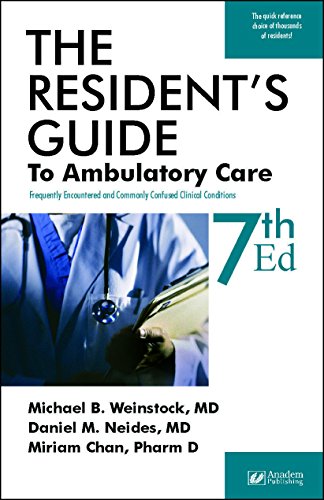
With sales of over 34,000 copies, The Resident s Guide to Ambulatory Care continues to be written by residents, for residents. The 7th edition includes 6 new chapters including child maltreatment, autism spectrum disorders, pneumonia in infants, occupational medicine, chronic pain management, and end of life care. Within these pages are the most recent national guidelines on a host of conditions with up-to-date charts, tables, algorithms and web links to living documents, all arranged for rapid reference; our goal is to provide the information needed while you are walking down the hall to the patient s room. The 7th edition provides state of the art information on evaluation and management of common ambulatory conditions in a straightforward, concise, and focused format.
